

We Aren't Just In the Loop. We Are the Loop.
I’m sick and tired of the phrase “the human in the loop.”

Ever since generative AI started reshaping the film and creative industries, this term has been tossed around as a comfort blanket.
But I hate it.
Not because it’s entirely wrong, but because it doesn’t go nearly far enough.
Calling us “the human in the loop” makes us sound like a checkpoint. A simple cog inside a machine we no longer control, placed there just to hit “approve” before the algorithm takes over again. It comes from a fundamental misunderstanding of two very different concepts: working with AI and fully automating the creative process.
They are not the same thing.
The writer Gurwinder recently said something I haven’t been able to shake: “Automate only the skills you’re willing to lose.”
AI doesn’t make art; it makes options. A human still decides what gets seen, what gets shared, and what gets remembered. We are not simply participating in an automated cycle. The human is the loop. Your vision, your taste, and your intent are the boundaries that give the machine its purpose.
To prove it, I want to pull back the curtain on how I actually put this philosophy into practice.
Orchestration Over Automation
My micro-series, Space Trash, began as a single short film. It has since expanded into a 31-episode narrative that will be fully distributed later this year.
When it came time to produce Episode 2, I knew that manually prompting every single shot, location, and character variation was going to be an agonizing bottleneck. I didn’t want an AI to just “generate a film for me.” I needed a system that could act on my behalf, understanding the highly specific, nuanced world of my robot CP, at a speed and scale I simply couldn’t reach alone.
The solution wasn’t one massive, complex prompt.
The solution was building an entire AI film crew inside invideo Agent One. I delegated the workload to a system of distinct, specialized agents, each with a specific job.
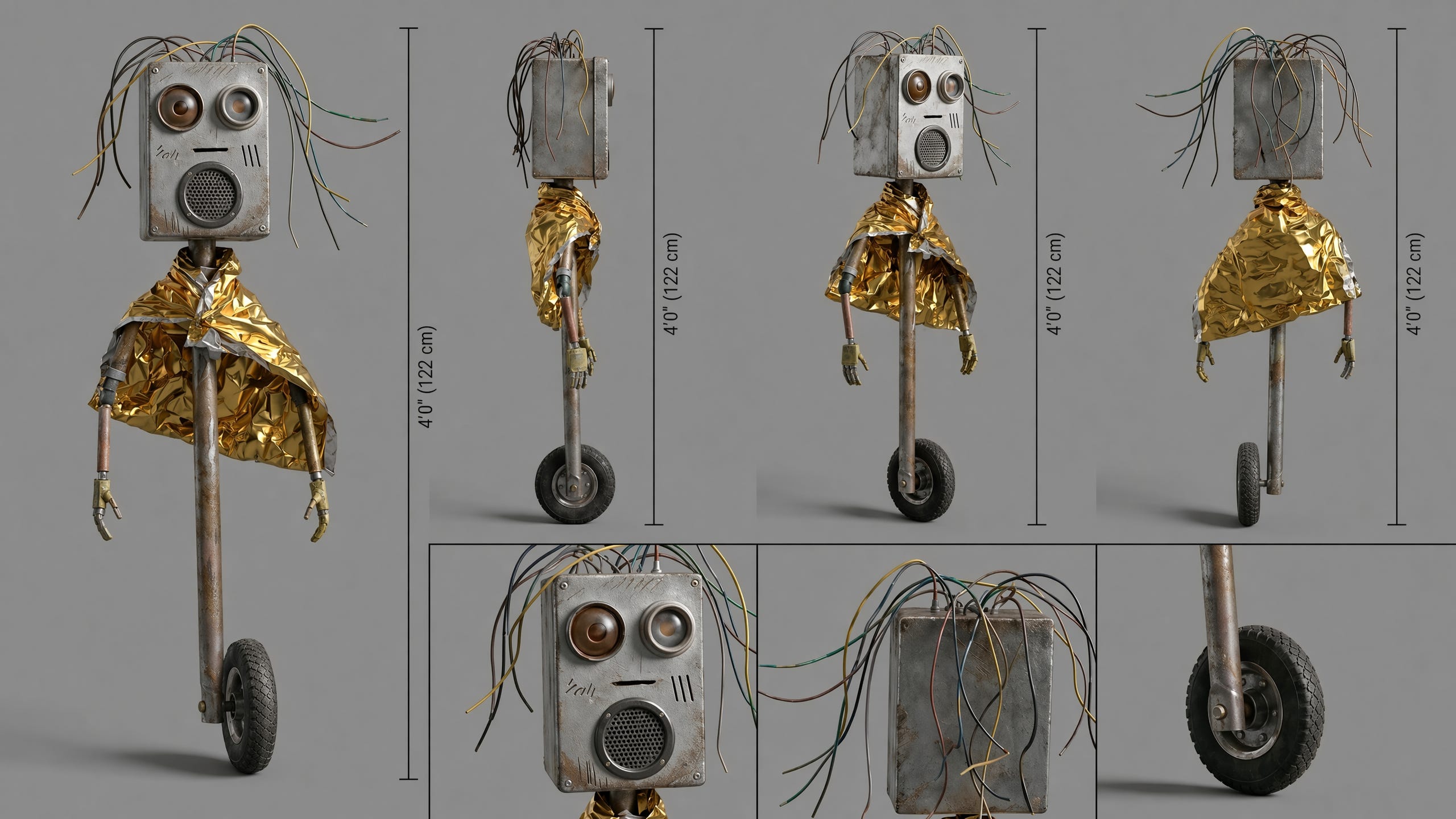
Here is exactly how I built my crew:
1. Overwatch (The Context Agent) This was my administrative hub. I fed Overwatch the entire series bible: character descriptions, season-long arcs, locations, tone, style, and the full season of scripts. Its job was to synthesize all that material into a master context file that every other agent could pull from. If it found gaps in the lore or missing location details, it flagged them.
2. The Character Creator I instructed this agent to act as an expert character sheet builder. Because I had already established characters from the original short film, I fed it my existing assets and asked it to rebuild each one with specific height markers and details required for consistent generation across scenes. It worked through my cast one by one, bringing up images for my approval before moving on. By the end, every character had a standardized, bulletproof reference sheet.
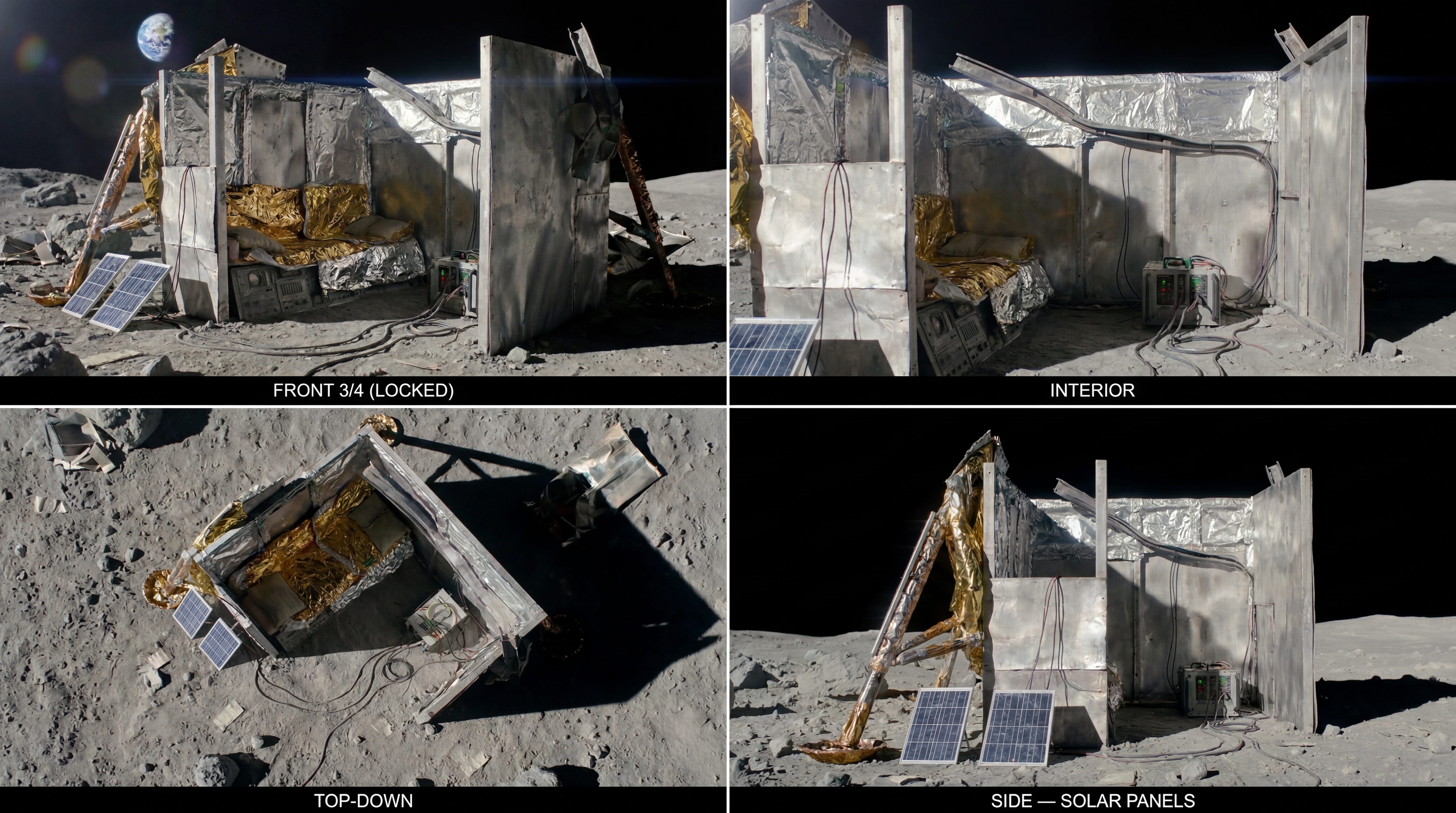
3. The Location Creator While the Character Creator was running, I built the Location Creator and put it to work simultaneously. The rule was simple: if I gave it a master shot, it had to generate a four-panel reference (master, top view, side view, and back view). This gave the whole “crew” a 3D understanding of the space.
For Episode 2, this was crucial. CP constructs his home from the ruins of a crashed rocket ship. The location changes within the story. So, I locked two separate location, first the ruins, then the finished build.
4. Cinematography This is where parallel processing stopped and sequential generation began. Video generation relies on sequence; each approved shot informs the one that follows. I gave the Cinematography agent my strict rules for prompt structure, the visual style, and instructions to work in 15-second chunks.
Pulling from the approved characters and locations already locked in the shared context file, I fed it sections of the script. The agent built the prompts as a structured shot list. Sometimes, it would intuitively divide a complex prompt into two separate takes if a shot needed multiple passes. Once I approved the generation, it used that output as the baseline reference for the next shot.
The Real Opportunity of Agentic Workflows
Because these agents were simultaneously pulling from and updating the same shared context file, I never had to hunt for the “right” approved image or update numerous node connections. The system simply knew.
From start to finish, this workflow cut my production time down to a third of what it would have taken to prompt every shot manually.
But it didn’t eliminate the craft of filmmaking.
Once the assets were generated, post-production happened exactly the way it always does. I brought the footage into Premiere Pro, upscaled the final clips to 4K, integrated the character voiceovers using ElevenLabs, and finished the episode with deliberate sound design and color grading.
These agentic systems are only going to get faster, more capable, and more autonomous. The temptation to hand over more of your creative process will grow right alongside them. That isn’t a threat; it’s just the reality of where the technology is heading.
The real question is what you are willing to automate, and what you demand to protect.
The filmmakers and creative teams who win over the next few years won’t be the ones who automate the most. They’ll be the ones who master orchestration. Use these tools. Push them absolutely as far as they can go. Build your own crews and scale your output.
Just remember: automate only the skills you’re willing to lose.
Your vision should never be one of them.
Be well, do good, and make awesome things.
About the Author
Gabe Michael is an award-winning AI filmmaker and creative technologist shaping the future of production with AI. He currently serves as Global SVP and Executive Producer of AI at Edelman, where he consults internal and external teams, enhances production workflows and explores new creative possibilities with AI.
As an early adopter of AI technology in film, video and creative production, Gabe’s work has earned accolades for ‘Best Odyssey’ at Project Odyssey, ‘Best Character’ and ‘Best Art Direction’ at the Runway Gen:48 AI Film Competitions, leading to his entry into many creative partner programs with top AI video tools.
With extensive experience as a director and producer in the creator economy, Gabe collaborates with top film studios, brands, and digital platforms, and shares his expertise on LinkedIn, YouTube, and in classrooms at UCLA.
📍 Website: gabemichael.ai
📺 YouTube: Gabe Michael’s Channel
📷 Instagram: @gabemichael_ai
📝 Substack: The Creative Possible
💼 LinkedIn: Gabe Michael
People worry about AI replacing judgement.
Most days I’m more worried about people switching theirs off because the answer looked confident.
"Automate only the skills you’re willing to lose" is such a sharp way to put it.
Orchestration over full automation is definitely the way forward. Great breakdown on the workflow.